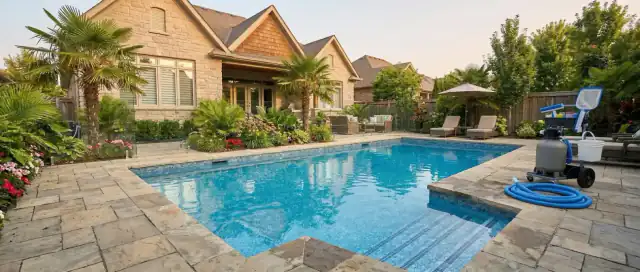
Most US pool owners spend $80 to $195 a month on routine pool maintenance. Once you add electricity, water, and the repairs that eventually come due, total annual operating cost lands between $1,500 and $4,000 a year for a typical residential inground pool.
Those are wide ranges, and the spread is not arbitrary. Two pools of identical size in different states, running different pumps, can differ by more than $1,000 a year. This guide breaks the number into its actual components so you can work out where your pool sits rather than guessing from an average.
The short answer
| What you're paying for | Typical cost |
|---|---|
| Routine maintenance, monthly | $80 – $195 |
| Full-service weekly plan, monthly | $150 – $350 |
| Doing it yourself, yearly | $1,200 – $3,600 |
| Full professional service, yearly | $2,400 – $5,000 |
| Total operating cost, yearly | $1,500 – $4,000 |
| One-off service visit | $55 – $780 (average around $236) |
| Technician hourly rate | $85 – $120+ |
The important thing to notice: the gap between the DIY figure and the professional figure is roughly $1,200 to $1,400 a year. That is the labour. Everything else on this page — chemicals, power, water, equipment wear — you pay either way.
What you actually pay for each month
| Line item | Monthly | Yearly |
|---|---|---|
| Chemicals | $30 – $60 (chlorine pools can reach $100) | $400 – $800 |
| Electricity | $50 – $100 | $250 – $840 |
| Water top-ups | $10 – $30 | $50 – $500 |
| Filter media and consumables | $5 – $15 | $60 – $180 |
| Professional service (optional) | $80 – $350 | $960 – $4,200 |
The first four rows are yours whether or not you ever hire anyone. Only the last is optional — which is why "should I get a pool service?" is really a question about your time, not your budget.
Electricity is the line item most owners get wrong
This is the single largest controllable cost in pool ownership, and most people underestimate it badly.
A single-speed pump running eight hours a day at $0.16/kWh costs roughly $840 a year on its own. A variable-speed pump doing the same job on the same pool runs $250 to $350 a year.
That is a difference of around $500 every year, indefinitely. A variable-speed pump typically costs $1,400 to $2,800 installed, so it pays for itself in roughly three to five years — sooner if your electricity is above $0.16/kWh, and sooner still if your utility offers a rebate, which many do. If you are running a single-speed pump and plan to keep the pool, this is almost always the highest-return change available to you.
Doing it yourself versus hiring a service
DIY maintenance runs $1,200 to $3,600 a year. Full professional service runs $2,400 to $5,000 a year.
What the difference buys you is about two to four hours a week during season — skimming, brushing, vacuuming, testing and dosing, backwashing, and checking equipment. It also buys a degree of insurance. Water chemistry is unforgiving in a specific way: mistakes compound quietly and then present all at once. A pool that turns green is not a $40 problem, and correcting a serious chemistry imbalance can cost more in a single visit than several months of routine service.
A reasonable middle path many owners take is professional service through the heavy months and self-maintenance through the shoulder season, or a bi-weekly plan rather than weekly if the pool is lightly used and covered.
Above-ground versus inground
Above-ground pools are cheaper to maintain on essentially every line. They hold less water, so they need less chemical; they run smaller pumps, so they draw less power; and their repairs are an order of magnitude cheaper.
The clearest illustration is liner replacement. An above-ground liner costs $500 to $2,500 replaced. An inground vinyl liner for a standard rectangular pool costs $3,000 to $5,500, with the full range across pool types running $1,200 to $7,500.
Saltwater versus chlorine
Saltwater pools are frequently described as cheaper to maintain. That is true month to month and misleading over the life of the system.
Routine chemical spend on a saltwater pool is genuinely lower, because the generator produces chlorine from salt rather than you buying it. But the salt cell is a consumable. It degrades and needs replacing every three to five years, at $300 to $1,000 for the cell itself, or $1,000 to $1,800 when replacement is done as a complete job.
Amortised, that is roughly $100 to $350 a year that a chlorine pool owner does not pay — which offsets much of the chemical saving. Choose saltwater for the water feel and the reduced handling of chlorine, which are real benefits. Do not choose it purely expecting to save money.
Opening and closing, if your climate needs it
Seasonal opening and closing services run $200 to $400 per visit, plus any filter replacements done at the same time. Budget for two of these a year — so $400 to $800 annually — in any climate cold enough to winterise.
This is the cost that catches out owners who move from a Sun Belt state to a northern one and assume their pool budget transfers.
Repairs: the costs that are not monthly
Routine maintenance is predictable. Repairs are not, and leaving them out is the main reason people's real pool costs exceed their expectations.
| Repair | Typical cost |
|---|---|
| Pump replacement | $700 – $1,300 ($1,400 – $2,800 for variable-speed, installed) |
| Filter replacement | $250 – $1,700 |
| Heater repair — natural gas | $150 – $750 |
| Heater repair — electric heat pump | $200 – $1,200 |
| Heater repair — solar | $50 – $400 |
| Vinyl liner replacement | $1,200 – $7,500 |
| Full resurfacing | $6,000 – $15,000 |
Pumps, filters and heaters are wear items with finite lives — they are not "if", they are "when". Setting aside a few hundred dollars a year against them turns a nasty surprise into a planned expense. Resurfacing is generational rather than routine, but it is worth knowing the number before you are quoted it.
Where you live changes the answer
Regional variation is larger than most national averages let on, and it runs in two directions at once.
- Texas: owners typically report $1,400 to $3,000 a year.
- Florida: typically $3,000 to $5,000 a year, with monthly maintenance averaging around $143.
- California: generally above the national average, driven by both labour rates and electricity prices.
Warm-climate pools cost more to run because the season never really ends — more months of pumping, more months of chemical demand, and higher evaporation. Cold-climate pools run for fewer months but add the opening and closing costs above, plus the risk of freeze damage if winterising is done poorly. Neither is straightforwardly cheaper.
Five ways to bring the number down
- Switch to a variable-speed pump. Around $500 a year, every year. Nothing else on this list comes close.
- Use a cover. Evaporation costs you water, the chemicals dissolved in that water, and heat. A cover reduces all three at once.
- Keep chemistry stable rather than correcting it. Small, consistent dosing is far cheaper than shock-treating a pool that has drifted.
- Right-size your pump run time. Many pools are run longer than turnover actually requires, out of habit rather than need.
- Match service frequency to real use. A lightly used, covered pool may not need weekly visits; a heavily used one in full sun almost certainly does.
Frequently asked questions
How much does pool maintenance cost per month?
$80 to $195 a month for routine maintenance is the typical national range. Full-service weekly plans run higher, at $150 to $350 a month.
How much does pool maintenance cost per year?
$1,500 to $4,000 a year in total operating costs. Self-maintaining owners land around $1,200 to $3,600; those on full professional service land around $2,400 to $5,000.
How much does weekly pool service cost?
Individual visits average around $236 and range from $55 to $780 depending on scope and pool condition. Ongoing weekly plans are cheaper per visit than one-off call-outs.
Is a saltwater pool cheaper to maintain?
Month to month, yes. Over the life of the system the salt cell — $300 to $1,000 every three to five years — absorbs much of the saving. Treat the two as roughly comparable and choose on water quality, not cost.
How much does above-ground pool maintenance cost?
Less than inground across every category, because of smaller water volume, smaller pumps and much cheaper repairs. Liner replacement is the clearest example: $500 to $2,500 versus $3,000 to $5,500 for an inground vinyl pool.
Does a pool cover actually save money?
Yes, and on three lines at once — water lost to evaporation, the chemicals dissolved in that water, and heating. It is the cheapest meaningful intervention available to most owners.
A note on these figures
Every number on this page is a national range drawn from published 2026 cost data, not a quote. Actual pricing varies with pool size, local labour rates, electricity cost, water cost, season length and the condition of your equipment. Use these ranges to sanity-check a quote, not to replace one.
Figures are compiled from published 2026 cost research including HomeGuide, Angi, Swimply and HomeGuide's pool repair data.